
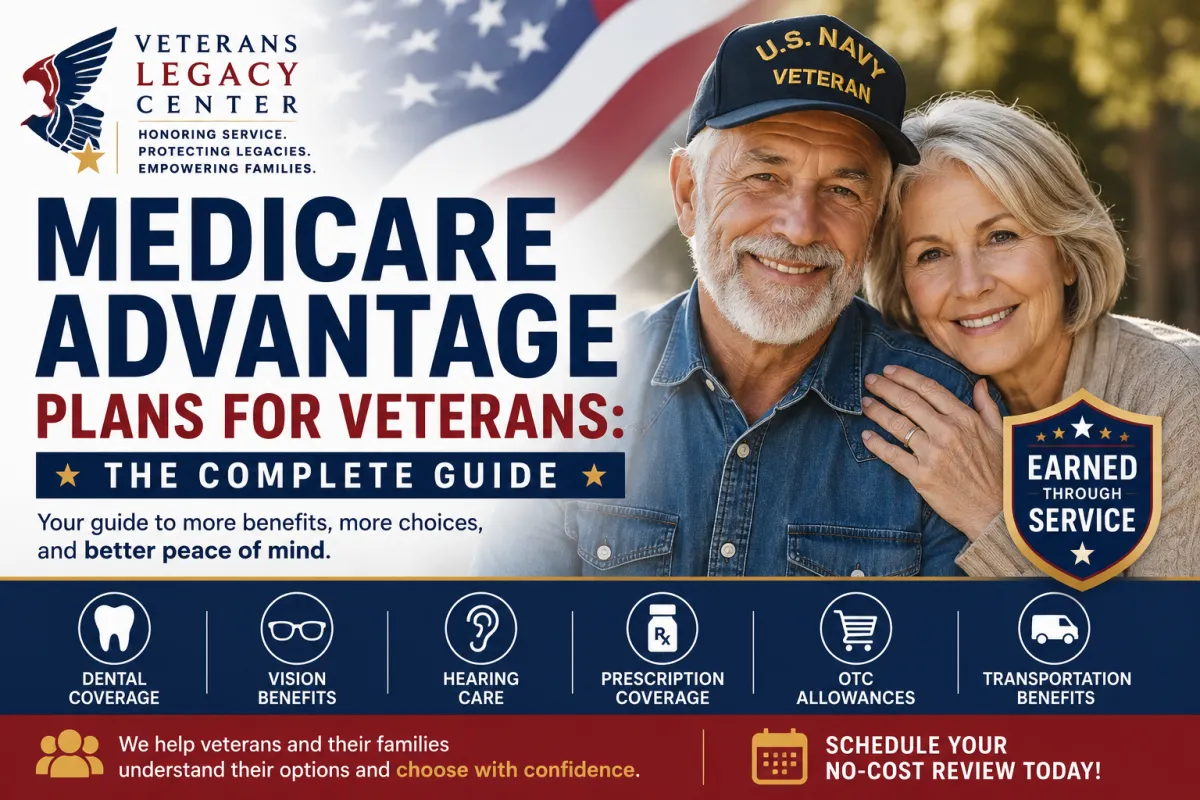
Medicare Advantage plans for Veterans: The Complete Guide
Table of Contents:
How Medicare Advantage Works with VA Healthcare
HMO vs. PPO Medicare Advantage Plans: Which Is Better for Veterans?
What Is an HMO Medicare Advantage Plan?
An HMO may be a good choice if you:
What Is a PPO Medicare Advantage Plan?
A PPO may be a better choice if you:
8 Things Every Veteran Should Compare Before Choosing a Medicare Advantage Plan
💊 2. Prescription Drug Coverage
🛒 6. Over-the-Counter (OTC) Benefits
🛡️ 8. Maximum Out-of-Pocket (MOOP)
Medicare Advantage vs. Medicare Supplement: Which Is Better for Veterans?
Medicare Advantage May Be a Better Choice If You:
Medicare Supplement May Be a Better Choice If You:
Common Mistakes Veterans Make When Choosing Medicare Coverage
❌ Assuming VA Healthcare Is the Same as Medicare
❌ Choosing a Plan Based Only on the Monthly Premium
❌ Ignoring Annual Plan Changes
Need Help Comparing Your Options?
Frequently Asked Questions About Medicare Advantage for Veterans
Can I have both VA healthcare and a Medicare Advantage plan?
Will I lose my VA benefits if I enroll in Medicare Advantage?
Do veterans need Medicare Part B?
Can I use my Medicare Advantage plan at a VA hospital?
What extra benefits do Medicare Advantage plans offer?
Is an HMO or PPO better for veterans?
Can I change my Medicare Advantage plan?
Does Medicare Advantage cover emergency care while traveling?
Are prescription drugs included?
Choosing the right Medicare coverage can be confusing, especially if you've earned healthcare benefits through the U.S. Department of Veterans Affairs (VA). Many veterans ask the same questions:
Do I need Medicare if I already have VA healthcare?
Is a Medicare Advantage plan worth it?
Can I use both VA healthcare and Medicare Advantage?
Will I lose my VA benefits if I enroll in a Medicare Advantage plan?
The good news is that enrolling in a Medicare Advantage plan does not replace your VA healthcare benefits. In many cases, the two can work together to provide more complete healthcare coverage both inside and outside the VA healthcare system.
While VA healthcare provides excellent medical care for eligible veterans, it is generally designed to be used through VA medical facilities and authorized providers. Medicare Advantage plans can help fill important gaps by providing access to civilian doctors, local hospitals, urgent care centers, emergency services, prescription drug coverage, and valuable extra benefits such as dental, vision, hearing, fitness memberships, transportation assistance, Part B premium reductions, and over-the-counter allowances.
The best Medicare Advantage plan isn't necessarily the one with the most benefits—it's the one that complements your VA healthcare, fits your lifestyle, and gives you access to the care you need when and where you need it.
In this complete guide, you'll learn:
What Medicare Advantage is
How Medicare Advantage works with VA healthcare
The advantages and disadvantages for veterans
How Medicare Advantage compares to Original Medicare
The difference between HMO and PPO plans
How to compare Medicare Advantage plans
Common mistakes veterans should avoid
Frequently asked questions about Medicare Advantage and VA healthcare
Whether you're turning 65, reviewing your current Medicare coverage, or simply exploring your options, this guide will help you make a more informed decision about your healthcare.
What Is Medicare Advantage?
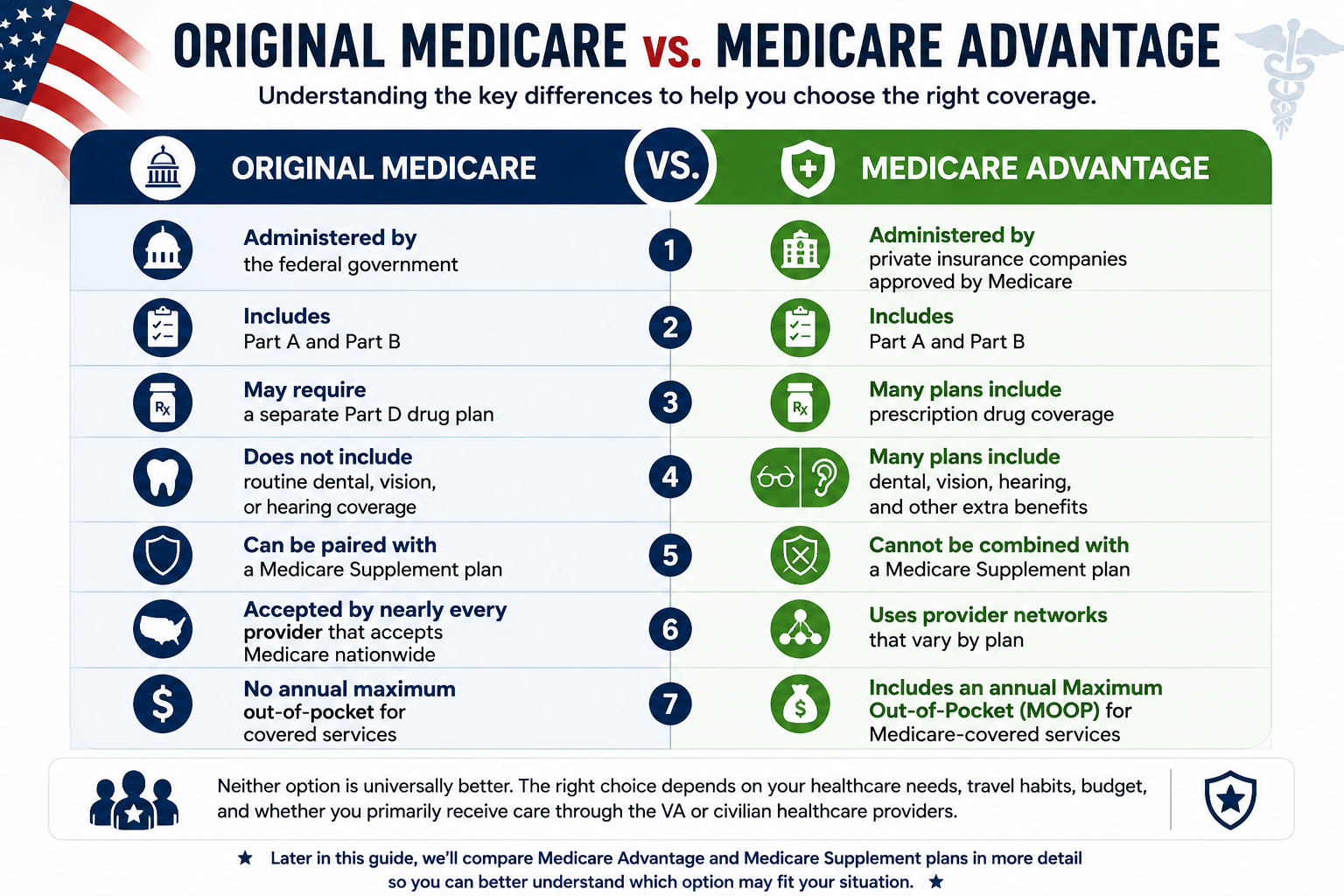
Medicare Advantage, also known as Medicare Part C, is an alternative way to receive your Medicare Part A (hospital insurance) and Part B (medical insurance) benefits through a private insurance company approved by Medicare.
Instead of the federal government paying your healthcare providers directly through Original Medicare, Medicare pays a private insurance company to administer your healthcare benefits. These plans are offered by insurance companies such as Humana, Aetna, UnitedHealthcare, Anthem, SCAN Health Plan, and many others depending on where you live.
Every Medicare Advantage plan must provide at least the same medically necessary services covered by Original Medicare. However, many plans go a step further by including additional benefits that Original Medicare typically does not cover.
These extra benefits may include:
Routine dental care
Vision exams and eyeglasses
Hearing exams and hearing aids
Medicare Part D prescription drug coverage
Fitness programs such as SilverSneakers® or similar wellness memberships
Transportation to medical appointments
Over-the-counter allowances for eligible health products
Telehealth services
Nurse hotlines and wellness programs
Because benefits, provider networks, premiums, and prescription drug formularies vary by county, it's important to compare plans available in your ZIP code before enrolling.
If you're new to Medicare, you may also want to read our Medicare 101 for Veterans guide, which explains the different parts of Medicare and how they work together before diving into Medicare Advantage options.
How Medicare Advantage Works with VA Healthcare
One of the biggest misconceptions among veterans is that enrolling in a Medicare Advantage plan means giving up their VA healthcare benefits.
Fortunately, that's not how it works.
If you're eligible for VA healthcare, enrolling in a Medicare Advantage plan does not cancel or replace the healthcare benefits you've earned through your military service. Instead, these programs generally operate independently, allowing many veterans to use each where it makes the most sense.
For example, you may continue receiving routine care, prescriptions, and specialty services through your local VA medical center while using your Medicare Advantage plan when you need care from civilian providers or hospitals that participate in your plan's network.
Here's a simple example:
Scenario 1: Receiving Care at a VA Facility
You visit your VA primary care physician for your annual checkup or receive treatment at a VA hospital.
Your VA healthcare benefits generally cover your care according to VA eligibility rules.
Your Medicare Advantage plan is typically not billed for authorized VA care.
Scenario 2: Visiting a Civilian Doctor
You develop a medical condition and prefer to see a local civilian specialist who participates in your Medicare Advantage plan.
Your Medicare Advantage plan generally pays according to the plan's rules, provider network, and cost-sharing requirements.
Your VA benefits generally are not used for that civilian visit unless the care has been separately authorized by the VA.
Scenario 3: Emergency Medical Care While Traveling
Suppose you're visiting family in another state and experience a medical emergency.
Your Medicare Advantage plan may provide coverage for emergency and urgently needed care according to the plan's benefits, helping ensure you can receive treatment even when you're away from your local VA facility.
This additional layer of coverage is one reason many veterans appreciate having both VA healthcare and Medicare Advantage.
Why Many Veterans Choose Both
VA healthcare is an outstanding benefit, but it wasn't designed to replace every healthcare need outside the VA system.
Many veterans enroll in Medicare Advantage because they want:
Greater access to civilian healthcare providers
Coverage when traveling away from home
Routine dental care
Vision exams and glasses
Hearing benefits and hearing aids
Prescription drug coverage outside the VA when appropriate
An annual limit on Medicare-covered out-of-pocket costs
Extra wellness benefits not typically included under Original Medicare
For many veterans, Medicare Advantage complements VA healthcare rather than competes with it.
The key is choosing a plan that aligns with your medical needs, preferred doctors, and lifestyle. In the next section, we'll examine one of the most important decisions you'll make: choosing between an HMO and a PPO Medicare Advantage plan—and why that choice can significantly affect how you access care outside the VA.
HMO vs. PPO Medicare Advantage Plans: Which Is Better for Veterans?
One of the most important decisions you'll make when selecting a Medicare Advantage plan is choosing between an HMO (Health Maintenance Organization) and a PPO (Preferred Provider Organization).
Both plan types provide the same Medicare-covered services, but they differ significantly in how you access civilian healthcare outside the VA system.
For veterans, the right choice often depends on where you receive your healthcare, how frequently you travel, whether you have preferred civilian doctors, and how much flexibility you want when seeking medical care.
Neither option is universally better. The goal is to choose the plan that best complements your VA healthcare while meeting your individual healthcare needs.
What Is an HMO Medicare Advantage Plan?
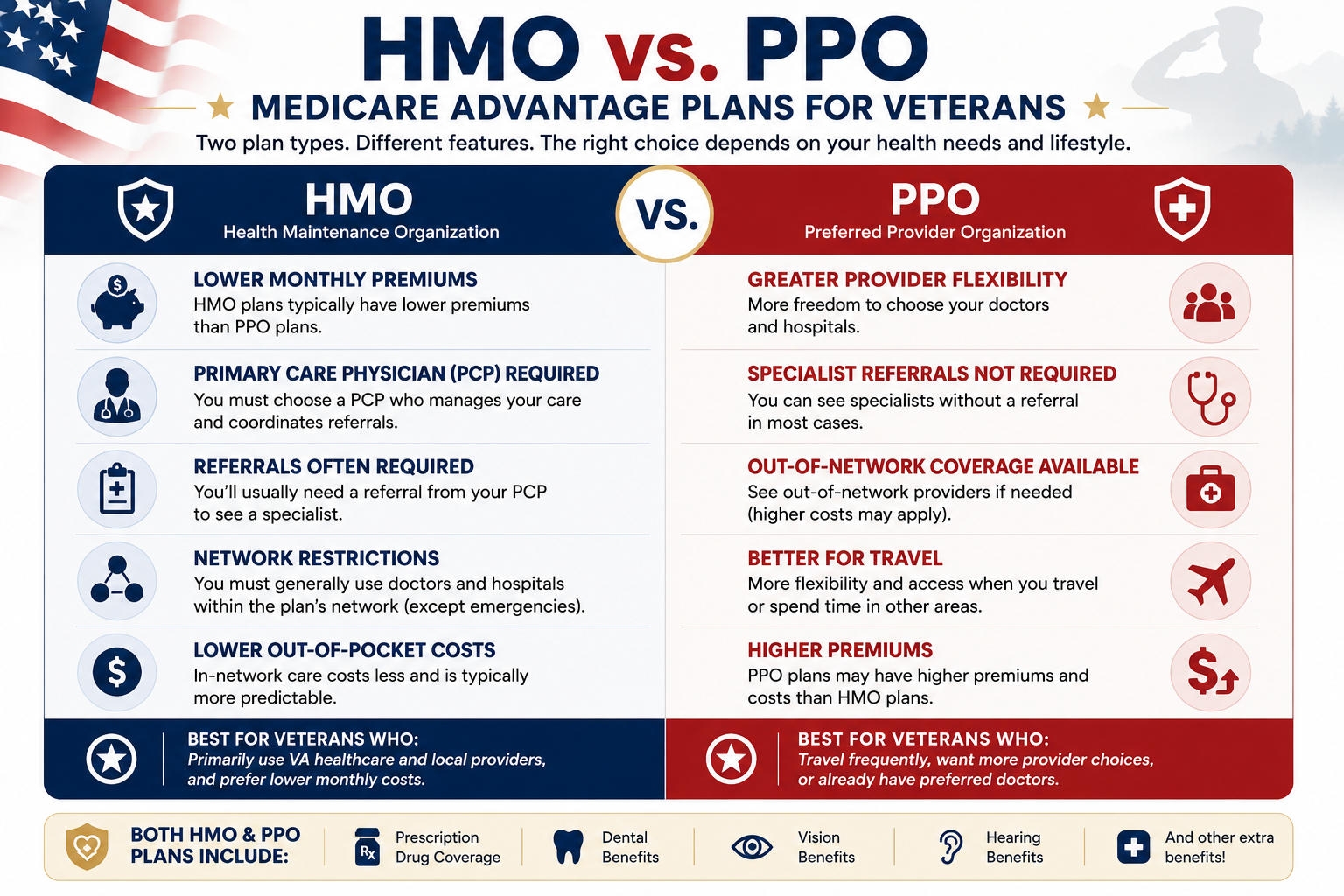
An HMO (Health Maintenance Organization) typically requires you to receive most of your non-emergency healthcare from doctors, specialists, and hospitals within the plan's provider network.
Many HMO plans also require you to select a Primary Care Physician (PCP), who coordinates your care and provides referrals when you need to see a specialist.
Because HMOs have more structured provider networks, they often offer lower monthly premiums and predictable out-of-pocket costs.
For veterans who receive most of their healthcare through the VA and only occasionally visit civilian providers, an HMO may provide an affordable way to gain additional benefits such as dental, vision, hearing, and prescription drug coverage.
An HMO may be a good choice if you:
Primarily receive healthcare through the VA.
Rarely visit civilian specialists.
Prefer lower monthly premiums.
Don't mind working within a provider network.
Receive most of your healthcare close to home.
What Is a PPO Medicare Advantage Plan?
A PPO (Preferred Provider Organization) offers greater flexibility when choosing doctors and hospitals.
Unlike many HMO plans, PPOs generally allow you to see specialists without a referral and often provide coverage for out-of-network providers, although you'll usually pay more when receiving care outside the preferred network.
For many veterans, this added flexibility is one of the biggest advantages of choosing a PPO plan.
If you travel frequently, spend part of the year in another state, or already have established relationships with civilian physicians, a PPO may provide greater convenience and peace of mind.
A PPO may be a better choice if you:
Travel frequently throughout the year.
Spend part of the year in another state.
Want the freedom to choose your own specialists.
Already have civilian doctors you trust.
Prefer having a broader network of providers.
Want fewer restrictions when seeking care.
Although PPO plans sometimes have slightly higher premiums or cost-sharing than comparable HMO plans, many veterans find the additional flexibility well worth the cost.
8 Things Every Veteran Should Compare Before Choosing a Medicare Advantage Plan
Choosing a Medicare Advantage plan isn't just about finding the lowest premium. The right plan should fit your healthcare needs, lifestyle, travel habits, and how you use your VA healthcare benefits. Before enrolling, compare these eight important features.
🩺 1. Provider Network
If you regularly see civilian doctors or specialists, make sure they're included in the plan's provider network. Staying in-network can help reduce your out-of-pocket costs and ensure you can continue seeing the providers you trust.
💊 2. Prescription Drug Coverage
Many Medicare Advantage plans include Medicare Part D prescription drug coverage. Compare each plan's formulary, pharmacy network, copays, and coverage restrictions to make sure your medications are covered.
🦷 3. Dental Benefits
Dental benefits can vary significantly between plans. Compare preventive services, fillings, crowns, dentures, implants (when available), and annual dental allowances to determine which plan offers the most value.
👓 4. Vision Benefits
Routine eye exams, prescription glasses, contact lenses, and eyewear allowances are common benefits offered by many Medicare Advantage plans. Review these benefits carefully if vision care is important to you.
👂 5. Hearing Benefits
Many plans include hearing exams and hearing aid allowances, but coverage amounts can vary widely. If you wear hearing aids or expect to need them in the future, compare these benefits closely.
🛒 6. Over-the-Counter (OTC) Benefits
Many Medicare Advantage plans provide a quarterly allowance that can be used to purchase eligible over-the-counter health products, including vitamins, pain relievers, first-aid supplies, cold medications, and other everyday healthcare items.
🚐 7. Transportation Benefits
Some plans offer transportation to approved medical appointments. This benefit can be especially valuable for veterans who no longer drive or who need assistance getting to civilian healthcare providers.
🛡️ 8. Maximum Out-of-Pocket (MOOP)
Every Medicare Advantage plan includes an annual Maximum Out-of-Pocket (MOOP) limit for Medicare-covered services. Once you reach that limit, the plan generally pays 100% of covered costs for the rest of the year. This financial protection is one of the biggest advantages Medicare Advantage plans have over Original Medicare.
Tip for Veterans: The best Medicare Advantage plan isn't always the one with the lowest premium—it's the one that provides the right combination of provider access, prescription drug coverage, extra benefits, and financial protection for your individual healthcare needs.
Medicare Advantage vs. Medicare Supplement: Which Is Better for Veterans?
One of the most common questions veterans ask is whether they should choose a Medicare Advantage plan or a Medicare Supplement (Medigap) plan.
The answer depends on your healthcare needs, budget, travel habits, and whether you primarily receive care through the VA or civilian healthcare providers.
Neither option is universally better—each has its own advantages.
Medicare Advantage May Be a Better Choice If You:
✔ You want an all-in-one Medicare plan.
✔ You'd like dental, vision, and hearing benefits.
✔ You want prescription drug coverage included.
✔ You prefer lower monthly premiums.
✔ You receive most of your healthcare through the VA or local providers.
✔ You're comfortable using a provider network.
Medicare Supplement May Be a Better Choice If You:
✔ You want the freedom to see nearly any doctor nationwide who accepts Medicare.
✔ You travel frequently throughout the United States.
✔ You prefer predictable out-of-pocket healthcare costs.
✔ You don't mind paying a higher monthly premium for greater flexibility.
✔ You want to pair Original Medicare with additional coverage rather than join a Medicare Advantage plan.
Every veteran's situation is different. Your military service, VA eligibility, existing doctors, prescription medications, and long-term healthcare goals all play an important role in determining which option is the best fit.
Common Mistakes Veterans Make When Choosing Medicare Coverage
Even experienced Medicare beneficiaries can make costly mistakes. Here are some of the most common ones to avoid.
❌ Assuming VA Healthcare Is the Same as Medicare
VA healthcare and Medicare are separate programs. Having one doesn't automatically replace the other, and many veterans benefit from having both.
❌ Choosing a Plan Based Only on the Monthly Premium
A low premium doesn't always mean lower healthcare costs. Be sure to compare provider networks, prescription drug coverage, copays, extra benefits, and the plan's Maximum Out-of-Pocket (MOOP) limit.
❌ Not Checking Your Doctors
Before enrolling, confirm that your preferred civilian physicians, specialists, hospitals, and pharmacies participate in the plan's network.
❌ Ignoring Annual Plan Changes
Medicare Advantage plans can change from year to year. Provider networks, drug formularies, premiums, copays, and supplemental benefits may all be updated, making an annual review an important part of protecting your healthcare coverage.
Need Help Comparing Your Options?
Choosing the right Medicare coverage doesn't have to be overwhelming.
At Veterans Legacy Center, we provide a no-cost Medicare Benefits Reviews for veterans and their families. We'll compare the Medicare Advantage plans available in your area, explain how they work alongside your VA healthcare benefits, and help you understand your options so you can make an informed decision with confidence.
Whether you're enrolling in Medicare for the first time or reviewing your current coverage, we're here to help you make the most of the benefits you've earned through your service.
Frequently Asked Questions About Medicare Advantage for Veterans
Can I have both VA healthcare and a Medicare Advantage plan?
Yes. Many veterans have both VA healthcare and a Medicare Advantage plan. Enrolling in Medicare Advantage does not cancel or replace your VA healthcare benefits. Instead, many veterans use their VA benefits for care at VA facilities and their Medicare Advantage plan for eligible civilian healthcare services.
Will I lose my VA benefits if I enroll in Medicare Advantage?
No. Your VA healthcare benefits are separate from Medicare. Joining a Medicare Advantage plan does not affect your eligibility for VA healthcare or the benefits you've earned through your military service.
Do veterans need Medicare Part B?
For many veterans, enrolling in Medicare Part B is an important decision because it provides coverage outside the VA healthcare system. If you choose to delay Part B, make sure you understand the enrollment rules and any late enrollment penalties that may apply. Your situation will depend on your VA eligibility, employment status, and other health coverage.
Can I use my Medicare Advantage plan at a VA hospital?
Generally, VA healthcare and Medicare Advantage operate separately. Care received through the VA is usually covered by your VA benefits, while civilian care is generally covered by your Medicare Advantage plan according to the plan's rules and provider network.
What extra benefits do Medicare Advantage plans offer?
Many Medicare Advantage plans include benefits beyond Original Medicare, such as:
Dental coverage
Vision care
Hearing benefits
Prescription drug coverage
Over-the-counter (OTC) allowances
Transportation to eligible medical appointments
Fitness memberships
Telehealth services
Benefits vary by plan and county.
Is an HMO or PPO better for veterans?
Neither is automatically better.
An HMO may be a good fit if you receive most of your care through the VA and want lower monthly costs.
A PPO may be a better option if you travel frequently, prefer more provider flexibility, or already have civilian physicians you want to continue seeing.
Can I change my Medicare Advantage plan?
Yes. Depending on your circumstances, you may be able to change plans during the Annual Enrollment Period (October 15 through December 7), the Medicare Advantage Open Enrollment Period (January 1 through March 31), or if you qualify for a Special Enrollment Period.
Does Medicare Advantage cover emergency care while traveling?
Yes. Medicare Advantage plans generally cover emergency and urgently needed care throughout the United States, even if you're outside your plan's service area. Coverage for routine care while traveling may depend on your plan, especially if you have an HMO.
Are prescription drugs included?
Many Medicare Advantage plans include Medicare Part D prescription drug coverage. However, each plan has its own formulary, pharmacy network, and copay structure, so it's important to compare plans carefully before enrolling.
Is Medicare Advantage free?
Most Medicare Advantage plans have low or even $0 monthly plan premiums. However, you'll generally still need to pay your Medicare Part B premium unless another program helps cover that cost. Depending on the plan, you may also have copayments, coinsurance, or deductibles for certain services.
Should veterans review their Medicare coverage every year?
Absolutely. Medicare Advantage plans can change annually. Provider networks, prescription drug coverage, premiums, copays, and supplemental benefits may all change from one year to the next. Reviewing your coverage each year helps ensure your plan continues to meet your healthcare needs.
Final Thoughts
Choosing a Medicare Advantage plan is about more than comparing premiums—it's about finding coverage that complements your VA healthcare and supports your overall health.
For many veterans, Medicare Advantage provides valuable access to civilian healthcare providers while offering additional benefits such as dental, vision, hearing, prescription drug coverage, transportation, and wellness programs. Others may find that Original Medicare paired with a Medicare Supplement better fits their lifestyle and healthcare goals.
The right choice depends on your individual situation, including where you receive care, whether you travel, your preferred doctors, and the benefits that matter most to you.
If you're still unsure which option is right for you, you don't have to make the decision alone.
Schedule Your No-Cost Medicare Benefits Review
At Veterans Legacy Center, we specialize in helping veterans and their families understand their Medicare options with clear, unbiased guidance.
During your no-cost Medicare Benefits Review, we'll:
Compare Medicare Advantage plans available in your area
Explain how they work alongside your VA healthcare benefits
Review your current coverage
Answer your Medicare questions
Help you determine whether a Medicare Advantage plan, Medicare Supplement, or another option best fits your healthcare needs
Our goal is simple: to help you make an informed decision and maximize the healthcare benefits you've earned through your military service.
Continue Learning
If you found this guide helpful, you may also enjoy these related resources:
We also encourage you to visit the official Medicare.gov website for the latest information about Medicare Advantage plans, enrollment periods, and coverage options.